Showing posts with label crossing bridges. Show all posts
We all need to be diligent advocates

Subscribe to JRS-UK Community Blog by Email
Louise Zanré, Director of JRS UK, shares her vision for a better world and invites us to join advocacy efforts alongside refugees to make the case for their dignity
Advocacy is one of the three parts of the JRS mission. We often spend a lot more time on accompaniment and service - I suspect because many of us attracted to working for JRS are what I think of as being at heart "people persons". We derive energy and inspiration from being present both with and two the people we accompany. We build relationships and endeavour to offer and to receive hope, dignity and justice through those relationships. And we often do not make enough of the advocacy opportunities we have had and the fact that peoples' lives are changed as a result.
Being a "people person" myself I get a great deal of pleasure from meeting new people and having the opportunity of explaining to them a little about the reality of the lives of the people we accompany, whether those left destitute by the asylum system in the UK or those who have been detained, and the work of JRS. As a person of faith and conviction I base much of that message I share on the values underpinning the mission of JRS. I dream of a new world of dignity and justice, where everyone is treated with equality and compassion. I hope that, when I speak to groups, or at events; when I have meetings with civil servants, politicians; when I attend network meetings of partner organisations; when I write articles, that I am able to speak with truth, compassion and with passion and that the people I address or meet with are better equipped to conceive of and to want to work towards that new world.
It is a big ask - of myself and of those listening - and I am sure that I am not always as effective as I might be. It is also a big ask as we are up against so much. There are too many myths about refugees and asylum seekers. The world is far from perfect and sometimes the issues we are confronted with can seem to be insurmountable. It is difficult to know what response to make to the fact that so many people are being forced to risk dangerous journeys to get to Europe; to the fears that so many people have over competition for resources, jobs, housing or health care provision.
However it is especially at this time when things can seem to be so dark and depressing that it is of particular importance that we do try our best to counter a prevailing message of blame, of not being able to be generous, of not being able to participate together in society.
A new immigration bill was announced recently in the Queen's speech. Unsurprisingly, the highlights make for pretty depressing reading - landlords having to check immigration status of prospective tenants to determine if they can legally rent housing to them, appeal rights only being permissible in immigration cases after deportation, making it more difficult for immigrants to get bank accounts, making money earned from illegal working the proceeds of criminal activity and therefore able to be confiscated, to name a very few. On top of existing restrictions they make the UK a very unwelcoming place indeed.
In the face of this we all need to be diligent advocates. We will be sharing with you campaigns against particular measures - whether to stop indefinite detention; to try and convince our government to resettle more refugees; or to lobby MPs about the immigration bill. But we will also be asking you to listen to the experiences of our refugee friends, their hopes and dreams. And we will be asking you to work with us to dream a new world, to try to be more welcoming ourselves in everything we do or say, to challenge injustice and to pray and reflect. Without our refugee friends and without you, nothing I nor JRS can do will substantially change things.
It is wonderful to speak out

Subscribe to JRS-UK Community Blog by Email
What can we do together to improve the lives of asylum seekers here in the UK? JRS UK staff and advocacy volunteers share what advocacy means to them.
Sr Margaret Baxter SSMN, Detention Outreach Co-ordinator, helped two detainees give evidence to the UK parliamentary inquiry on detention via a video link, co-wrote JRS UK’s submission to the inquiry and herself also spoke at the launch of the report.
"For me, being involved with advocacy means to create an opportunity for the detainees I work with to self-advocate, then to help them prepare. For example, for the detention inquiry, we all wanted to be clear on what we wanted to say, so that it was a balance of their experience. On the moment of the hearing, I sat with them and then took each one into the room and then left, to allow them to speak for themselves. When they came out of the interview, I saw a liberated delight in these young men who had been empowered and now able to speak for themselves. That their stories were taken with credibility was in contrast to their experience of coming into country and making their asylum application against disbelief. There is nothing like the sincerity of the person themselves advocating on their own behalf. And with the detainees, there is a sense of solidarity with one another, even in the midst of their vulnerability."
Souleyman Sow, refugee poet and anti-detention campaigner, used to attend JRS UK’s Day Centre and now often speaks at events to explain the negative impacts of detention on the lives of vulnerable detainees, most recently at a school sixth-form education day.
"To be honest, before getting involved in campaigning, I did not know where I was, I had nowhere to start. It lifts me up and puts me on my feet and without it I would be somebody else. My main message is detention. It has an impact, it keep people in limbo. So to decision makers, I say that we have to put detention on trail, it is a waste of tax payers’ money. And let’s have a time limit on detention and we will see some of the problems for detainees ended. It is wonderful to speak out, I have been a tour guide, I have spoken at the parliamentary inquiry. Advocacy is not about money, it is not about food - you have to get involved in the community, after your release what have you contributed to the community? When I see my colleagues, I tell them come and get involved. So just involve yourself!"
The story of a refugee is a story of great courage

Subscribe to JRS-UK Community Blog by Email
Rome, 20 June 2015 – Refugees do not choose to become refugees. They become refugees out of compulsion. They experience separation from loved ones, starvation, discrimination, fear, trauma, indefinite incarceration and worst of all, the demonization of their human dignity. They hope not only for survival, but for a peaceful and decent life, free from persecution and discrimination. Even when they eventually do make it to a safe refuge, it is very hard for them to restore their lives by themselves. During this time, their hope for education and equal opportunity often fades away.
My name is Antony Mukui*; I'm 28 years old and I come from Kenya. My story, though tragic, is sadly not unique.
I should say that compared to the millions of refugees across the world, my journey has been through God's grace a fairly easy one.
It was the night of 5 November 2013, when my family and I were attacked in our home by a gang of about 12 men armed with crude weapons: machetes, axes, knifes, etc. I was outside of our house talking to my cousin Joseph inquiring why the electricity shut off. As we talked, this gang confronted us. They took me hostage and ordered my cousin to go back to sleep. Little did I know that was the last time I would see him alive.
I was led to the house and the ordeal began. All the while, they were looking for my mother, who was then an employee in one of Kenya's security services. This ordeal lasted just about an hour, and at the end of it all I was injured terribly. My young sister, 12 at the time, had gone through an attempted rape; my 92 year old grandmother had been harassed and traumatized; and my friend and colleague Peter was seriously injured and had to spend two months in the hospital undergoing reconstructive surgery on his mouth.
As you can all imagine after such a traumatic event, we lived our lives in fear, sleeping in shifts at night. While the local police guarded our compound, we stood watch too. The investigations were going nowhere; and after four months of this, we made the decision as a family to leave the country that we had called home for all our lives into an uncertain future.
A new home. We arrived in Italy on 21 January 2014. Based on the recommendation of by the Kenyan Superior of the Jesuits and with permission of the Superior General of the Jesuits, Franciscan Cappuchin priests took us in their San Lorenzo di Brandisi college, where they usually house foreign students who are studying in Rome. We have been living with them ever since.
They have helped us not only by offering us a roof over our heads but also a place to heal our inner wounds by providing us with spiritual counseling and allowing us to be part of their family. We eat meals together, have discussions, play football and watch games together from time to time.
This transition has not been easy on my family, leaving everything behind: a good house, good jobs, a car, all our friends and family. The life of a refugee is not an easy one; there are many challenges that one has to go through including the lack of employment, housing and proper documentation.
Rebuilding through faith. Worse for me is the feeling of not belonging, of not being human. As a refugee, every day you cling on to the hope that the next day will be better than yesterday. This hope and our faith in God is what have kept our family together over the past year, despite all the difficult times that we have faced. It is the faith that as long as we have our lives, we can always rebuild and achieve greater things.
Every day, I am inspired by the stories of my fellow refugees that I meet from all over the world. Many of them are young men and women like myself who have undergone so much pain and suffering in their young lives, but who all have two things in common – hope and determination to make something of their lives despite all the challenges they face.
Ultimately, I must say the story of a refugee is a story of great courage. It is a story of a people who refuse to give up when everything around them seems to crumble, who chose to hope when it would be so easy to give up.
I challenge all of you to look at refugees as your fellow brothers and sisters, as human beings.
I believe that we can all do our part to help those who are suffering. As Pope Francis reminds us, we must all be able first to see, and then help others to see that migrants do not represent a problem to be solved. They are brothers and sisters who need help and should therefore be welcomed and loved.
Each one of us must answer the Holy Father's call not only by helping to provide housing, food, employment and education, but more importantly to tackle the root causes that cause people to flee and find durable solutions to those problems.
Opposing the war in Vietnam, Martin Luther King Jr., said "a time comes when silence is betrayal." That time I believe has come for us as far as the refugee crisis is concerned. The time has come for all of us to not only speak up, but to act. This I believe is our duty not only as Christians but as human beings, and in doing so, we will love our fellow man and "Push forward, not back."
*Antony currently volunteers at the Jesuit Refugee Service International Office
This piece first appeared on the JRS International website: http://en.jrs.net/index
From Persecution to Punishment: A Second Exile

Together with Sr Margaret from JRS, Souleyman gave a workshop to Fifth Former’s of Stonyhurst College. We asked him his impressions and reflections after the workshop.
He was grateful that the hall welcomed them warmly. For him, the students showed ‘a scholarly purposefulness and positive approach’. He was also happy to see the pupils listen very intently and show ‘honest desire’ to know about the detention situation for asylum seekers in this country.
In the workshop, he posed the question “what part of our mission statement do you believe to be primary and vital?’ After a careful thinking, a young man suggested that it was ‘accompaniment, as a platform to explore’ and ‘the impact of being a healing presence in a very negative environment’. It was a person-centred approach to the issue of detention.
Souleyman saw that the students were particularly interested in personal stories. They were thirsty to understand questions and realised prayer always supports detainees. They also understood how important it is to write to their MPs. Responding to their desires to surf and broaden their knowledge about the issue, he gave the students the addresses of some of the useful Internet websites.
At the end of the workshop, Souleyman prayed together with over three hundred students in Stonyhurst College. Here is their prayer, or rather, a prayerful poem.
God’s plan is always the best.
Sometimes the process is painful and hard.
But don’t forget that when God is silent,
he’s doing something for you.
Subscribe to JRS-UK Community Blog by Email
Tag :
accompany,
advocate,
asylum seekers,
college,
crossing bridges,
JRS,
listen,
reflection,
young people,
Advent Together

Kate and Rosemary both took part in Pax Christi’s annual Advent Service at St Aloysius church near Euston in London this week. Kate shares what she enjoyed about the occasion.
Jesuit Refugee Service UK was invited to offer a testimony and focus for prayer for a gathering of people who work for justice all the way through the year. We were together to listen to stories, reflect on scripture and sing. The event was both intercession for people who all year round struggle in impossible circumstances and a festive celebration at the same time.
This service was particularly important to me. It was beautifully designed and presented with a lot of thought and love - whether through the choir, Westminster Deaf Service interpreters or the different creative stations for prayer. It is not often that I feel my worship truly reflects my work and commitment to working for peace. So I am grateful that on occasion we were able to honour refugees, those caught up in the troubles in the Holy Land, women who suffer from violence and those who seek to transform conflict throughout the world.
Each theme had a scripture verse, a personal story, a prayer from Pope Francis or a litany and a song. During the service we were all invited to make a pilgrimage around the church to each area, by way of accompanying people throughout the world who find themselves in situations of flight, discrimination, trafficking or isolation. We sang in English, Arabic and Hebrew and made a commitment to instil in our hearts the courage to take concrete steps to achieve peace. It meant a lot to me to share those words with a mix of people who I know do that in their daily lives.
After the service, we all went downstairs to share a mince pie and glass of wine. JRS had a stall with crafts made by refugees in Kenya (www.jrsea.org/mikono) and sold more than £100 of products. Thank you to everyone who bought something from us.
Read more about Pax Christi’s work: www. paxchristi.org.uk
Read more about JRS’ work in Syria: http://en.jrs.net/campaigns_
The collection was taken for Pax Christi and JRS Syria. You can donate here: https://en.jrs.net/donate
Tag :
accompany,
advocate,
bound together,
Britain,
Christmas,
crafts,
crossing bridges,
friends,
human beings,
london,
peace,
pope francis,
prayer,
reflection,
refugee,
sharing,
visit,
voice,
JRS Europewide!

Our volunteer Liliane
visited Romania from 13th to 15th Oct to take part in a
JRS meeting. She kindly answered for an interview after the trip.
Q: Tell me about the event in Romania. What was the
occasion?
Liliane: It was JRS Europe Annual General Meeting. The topic
was Accompaniment this year. In the workshop, JRS staff and volunteers from all
around Europe participated. From our JRS UK, Jonathan, Kate, Sr Margaret and I
participated.
Q: What did do you and learn?
L: During the three days, we looked around a hostel for
asylum seekers run by the city council in Bucharest, attended workshops, and
visited JRS Romania main office, ‘My place’ as they call it. And we had a
chance to see the sights and to have meals out to enjoy each other’s company.
We also had a Mass together on the last day of our visit.
In one of the workshop sessions, we were divided into small
groups and discussed. Afterwards we had presentations. In the first workshop,
the questions were what the difficulties we face in our working places were,
why they were difficult, and how we solved the issues.
We also listened to the differentprocesses of welcoming
refugees in various countries and we talked about how to accompany others. I
learned, in order to accompany them, we need to be passionate and listening to
them attentively.
I could see that different countries have different
situations. I met one refugee who was complaining about the lengthy process he
had to undergo, but I told him that in some other places, it could be worse.
I also saw that JRS Romania was doing many good works.For
example, they run language courses, help the refugees to obtain citizenship and
accommodation, and give legal advice. It is possible because they have many
staff members.
Q: How did you feel about this trip and what did you like
most?
L: I was very excited about this trip because it was the
first of such a kind of trip in ten years. It was great to meet people from
different backgrounds and to share our works with each other. I learned a lot.
And the place we stayed was also very nice.
Q: Finally, anything you would like to say?
L: Well, I really enjoyed the trip and am grateful to JRS
for giving me this opportunity. I am also proud of our JRS UK for what we do.
Thank you very much.
Subscribe to JRS-UK Community Blog by Email
Tag :
accompany,
advocate,
asylum seekers,
befriending,
crossing bridges,
Europe,
JRS,
refugee,
sharing,
travel,
volunteers,
welcome,
workshops,
Poem - In London
 |
| London Eye - by Christopher Chan |
Charles wrote a poem about this city London.
In London
by Charles
In a place where I thought that Big Ben is the best sight to see.
In a place where I thought that Buckingham Palace is the best castle to see.
In a place where I saw green because Wimbledon tournament is on grass and green.
In a place where I thought, women are powerful, because the ruler is a Queen.
In a place where women can choose regardless of their background, as dear Princess Diana did.
But London, with Hooliganism, you gave us the impression that you are not immaculate.
But London, you start your shy revolution with Protestantism.
But London, you gave us the impression that you are the best place to acquire education.
Although you, London are welcoming, life is hard in you.
Although you, London are very tolerant, racism still exists.
Although you, London are equal, competition is tough – London, you may have saved some lives but you did not save our soul.
Subscribe to JRS-UK Community Blog by Email
Tag :
asylum seekers,
bridges,
Britain,
community,
crossing bridges,
friends,
home,
human beings,
listen,
london,
poetry,
reflection,
welcome,
welcoming,
workshops,
writing,
A Visit of Heart to Heart

London, 04 July 2014 - In this testimony from the UK a JRS volunteer describes her unexpected encounter with an Afghan man held in an immigration removal centre. This chance meeting of two people, one free and the other detained, reveals a surprising role-reversal and highlights the inner human spirit that knows no borders.
One day I made an unscheduled visit to the detention centre. Neither the officials nor the detainees were expecting me, so I settled down in the multi-faith room and looked around at the books of different religious texts, the floor, the walls, and the carpet. There were no windows in this room making it impossible for anyone to connect with the outside world. Time passed slowly and alone I began to regret not informing the centre of my intended visit.
Then suddenly I saw Feizal.
When I first met Feizal he was very pale and was constantly being admitted to hospital. Often depleted of energy, he seemed withdrawn and sad. English is not Feizal's first language and he struggled to express himself the first time we met. However, today was different.
Like most detainees, Feizal has a sad story. Feizal's hometown is in Waziristan, a troubled border area between Pakistan and Afghanistan. The Taliban killed his father and then tried to force Feizal to fight for them. A school teacher, and a pacifist, he could think of nothing worse than killing another human being: so he refused. Consequently, the Taliban issued an order that Feizal be killed. He had to go into hiding. Feizal's mother managed to give him enough money to travel to the UK.
As soon as Feizal reached the UK he claimed asylum. His claim was refused and he was placed in immigration detention.
On seeing me sitting alone, Feizal immediately came up and sat next to me. His health had greatly improved and his downtrodden demeanour was replaced with one of strength. His English had also greatly progressed.
Feizal told me stories of his childhood and how he loved playing cricket. I complimented him on his dramatic improvement in English: he said this was due to him attending English classes at the detention centre. In the future, he hoped to teach English.
One gesture that will always stay with me was when Feizal pointed upwards and said with a big smile, "Above everyone, above the Taliban, above the law, there is Allah."
Despite all of his difficulties, Feizal still retained complete trust and confidence in God.
I left the centre feeling extremely humbled. I had set out with the intention of helping detainees. Instead, I had received care from a detainee. Although Feizal had so many problems of his own, he cared about my well-being and spent nearly an hour trying to make me feel valued, so that I wouldn't feel I had wasted my time in coming to the centre.
I realised that Feizal's actions were ones of true love: the giving of the self to the other. Feizal did not have money, did not have power nor even his liberty but still he had his heart and he chose to use it to make me feel better. And for that I will be forever grateful.
---
Bianca Venkata is a volunteer member of the JRS UK detention-outreach team and visits detainees at an immigration removal centre in the UK.
If you would like to join as a volunteer, come and visit JRS UK Volunteering.
If you would like to join as a volunteer, come and visit JRS UK Volunteering.
A Poem dedicated to JRS
 |
| Above: The Parents - Woodcut by Kathe Kollwitz(1867-1945) |
The following poem titled 'Refugees' is written by Fr Patrick Purnell SJ, especially for JRS. The poet gives us a vivid picture of refugees with a dignified voice despite their agonising situations.
Refugees
by Patrick Purnell SJ
Stealthily, we moved from the edges,
Drawn by dreams of plenitude,
Leaving our homes at the margins
Of the deserted flatlands,
Where nothing grows
And what we had of wheels and cogs
Grow rust and harbour cobwebs.
It was fear that urged us on,
Hacking at our hearts,
Fear of the demented power,
That fed upon its own illusions
And cut the naval string
Which bound us to our Tribal Story.
We were stripped at gunpoint
At the precise point of intersection
Between what passed as frontier of the
Nations.
We carry nothing with us
But the golden memories
Of a love that had once
Bound us together as a people,
The incense of a gifted race
Which had ministered a fruitful land for a thousand years
And we carry, like a sacrament,
The myrrh of our Nation’s woundedness
In which is mixed the wisdom of our ancestors.
This is who we are.
These are our gifts,
As we stand before your walls
And if this is not enough
To gain entry to your land,
Let the sun come down
Upon our dry bones
And the moon carve us a grave.
Subscribe to JRS-UK Community Blog by Email
Tag :
advocate,
asylum seekers,
beauty,
belief,
courage,
crossing bridges,
expression,
JRS,
Leave to remain,
voice,
writing,
Come and See: Photography Workshop (Part II)

With the launch just days away, we have a little time to reflect further on what we have enjoyed about taking part and what it has meant to us, both as participants and volunteers.
The photography workshop has had a great impact on everyone involved, not just because it has taught people a new skill, but because of the socialising and support it involves. As one more participant expressed said, it has certainly helped people grow closer together. From the point of view of us as new interns at JRS, the workshop has played a huge role in getting us involved in the organisation and building rapports with its members.
With the workshop being so engaging, as we volunteers have been busy working alongside Fotosynthesis and JRS-UK to organise a public photo exhibition, titled; “Come and See” in the Lumen Gallery. As well as this being a great opportunity for the participants to display the work they’ve created over the past twelve weeks, some have said they would not have had the courage to partake in anything like this without the workshop. J said that the workshop has given her more “confidence” in her abilities; “Before I felt scared about taking pictures but now I feel very confident.”
J, who had an interest in photography beforehand, says she had no idea about storytelling through photography before enrolling in the workshop, and feels that she now has “a new skill”. She also believes that while the workshop has allowed her to develop new skills, what she really enjoyed was “going out with others and to places I’ve never been before. Taking pictures in beautiful places in Wapping, near JRS’s office, and in the city, and taking self portraits with a real camera. I want to have brand new skills and this can open the doors to being self-employed.”
What’s even more positive is how the workshop affected the group as a whole. J said that her favourite thing about joining the workshop was “attending the classes, it’s very sociable. Watching others tell their story. It brings us closer together. The support from everyone - from the teachers and the volunteers.”
Participants, teachers and volunteers invite you to join them at the Lumen Gallery for “Come and See” photo exhibition, which opens for a preview night on the 26th June from 6pm-8pm and continues until the 10th of July from 8am-4pm when it will be open to the public. The Gallery Tour will be on the 5th of July and will be an excellent chance to hear about the experiences, inspirations and what the workshop and exhibition has taught everyone.
For more details, see www.jrsuk.net
Lumen Gallery, Church Cafe, 88 Tavistock Place, WCIH 9RS.
Subscribe to JRS-UK Community Blog by Email
Tag :
accompany,
advocate,
crossing bridges,
exhibition,
expression,
globalisation,
JRS,
life,
london,
photography,
refugee,
workshops,
Come and See: Photography Workshop

For the past weeks, a group of nine men and women have come together at JRS-UK to take part in a photography workshop run and facilitated by Fotosynthesis, a not-for-profit organisation that uses participatory photography to develop skills, give a voice to people and encourage community cohesion. The exhibition launch is just 2 weeks away…
Every week, we meet with the group of nine, who are all from different countries, to learn techniques, share ideas and practice different types of photography - portraits, candid shots, narrative, scenery and landscape. It has been great so far and the feedback we have heard from participants has been really positive with everyone taking something different away from each session.
Sergei, whose father was a photographer, shared he joined the workshop to “avoid depression”. He said that he felt the workshop gave him an opportunity to “communicate with creative people” and to revisit his previous interest for photography, now revived with a new knowledge of modern technology. “When I learnt photography, everything was black and white and manual cameras. Everything changed for 20 years, it changed completely”.
Yus, who hopes to do blogging in the future, joined the workshop when the opportunity presented itself, although he admitted to us he had not had an interest in photography before enrolling. He told us: “What I enjoyed most about what we’ve learned so far is the positioning of the camera and also the lighting. How to make sure you position yourself to get the quality you are looking for, 1. And 2, you have to have a picture in your mind of the story that you are trying to tell. “
Since joining he has been very pleased with how much his skills have advanced, by learning different techniques and tips from the workshop: “You don’t have to be in a rush. Sit still, or stand still, make sure you have the picture in your head before you snap. And as a result of doing that, it will translate into the picture which has helped me a lot,” he said when talking about the new techniques he has learned. He even expressed an interest in continuing to study photography after the workshop ends: “Maybe in the future I might go back to study it more, maybe in the college or something because I’m beginning to see that there’s certain things to consider, you don’t just take the camera and snap.”
"Come and See" opens on the 26th of June for the preview night from 6pm-8pm and continues until the 10th of July from 8am-4pm when it will be open to the public. The Gallery Tour on the 5th of July, will be a great opportunity to hear more from Yus, Sergei and the other contributors about their ideas and inspirations and what they have learnt.
More details see: www.jrsuk.net
Lumen Gallery, Church Café, 88 Tavistock Place, WCIH 9RS.
Subscribe to JRS-UK Community Blog by Email
Tag :
accompany,
advocate,
crossing bridges,
exhibition,
expression,
globalisation,
JRS,
life,
london,
photography,
refugee,
workshops,
A Mass for Migrants & A Message for me!

St. Frances Cabrini - the Patron Saint of Migrants
Statue in St. George's Cathedral, Southwark
‘The Mass for Migrants has been celebrated every May bank holiday since 2006, when it was first introduced by the then Archbishop of Westminster, Cardinal Cormac Murphy-O’Connor; at the suggestion of London Citizens. The Cardinal’s call at that Mass is for a more just treatment of migrants rooted in Catholic Social Teaching. Each year since then the event has reminded London of the invaluable contribution of so many migrants to the city’s society and economy. It offers a profound witness to the Church’s insistence that the dignity of the human person is God-given and never withdrawn and reminds us of the deep resonance with refugee and asylum seekers.’ (Extract from introduction in Mass booklet)
It was my privilege to be able to be there yesterday at a packed Westminster Cathedral. Before the Mass commenced the colourful and joyful procession of different migrant communities with their banners, music and dressed in their national clothes was indeed an Alleluia! Alleluia! Alleluia celebration. Bishop Patrick Lynch, one of the auxiliary bishops of Southwark, concelebrated with approximately fifty priests from Westminster, Southwark and Brentwood dioceses. It was noticeable that almost a third of the priests were from outside Europe. A blessing for our Church here in England and Wales today. VIPs included mayors/mayoresses from different boroughs of London, MPs, ambassadors of various countries and representatives from other faiths and Christian denominations. But THE VIPs were the migrants, each and everyone present from all over the world not only in this great city of London but in UK. Bidding prayers were in Polish, Mandarin, Swahili, French, Portuguese, Tagalog and English, a wee taste of the languages spoken in London churches. When the Our Father was prayed each according to their own native tongue, it did remind me of Pentecost! Poignantly, given recent events in his country, the Communion anthem was performed by a Ukranian soloist.
It would not do justice to Patrick Lynch’s profound homily to try to share what he said and I wish I had a copy to write it here. He quoted strongly from Evangelii Gaudium. He highlighted two main areas: Human Trafficking and Children of undocumented migrant workers, ‘no way in and no way out’ in their plight. Hopefully those present who have the clout to do something will not turn a deaf ear. As a volunteer at L’Arche and Jesuit Refugee Services, I have no clout, but that does not exempt me from not turning a deaf ear to God’s message for me. I found myself inspired, challenged, disturbed and consoled, all at the same time as I left the Cathedral and made my way to Colnbrook detention center for my weekly visit there.
Subscribe to JRS-UK Community Blog by Email
A Short Interview on a Workshop Experience

Recently, Nas and Kate visited Stonyhurst College for a workshop in order to explain the situation that asylum seekers are facing in the UK. It was by an invitation from the college for a special day for the pupils to look at their values and learn about different communities or issues outside of their own experience.
Nas said “We tried to explain to the pupils the difference between a refugee, an asylum seeker, a migrant and an internally displaced person. We also showed them a video about people who experience destitution in the UK. We did a quiz to challenge their assumptions about why refugees come here. I took the opportunity to talk about my experience of destitution.”
Kate said “We shared the approach of JRS to be welcoming and to respect people as individuals, not to stigmatise them or think that refugees just come to Europe for better opportunities. We tried to explain that people come for safety and they are courageous.” She also shared “I think to start with they had some understanding but did not really appreciate the difficulties; but when they saw the stories of our JRS refugee friends and heard Nas’ story, they had a new respect for asylum seekers.”
Nas agreed. “They were emotionally responsive and also they made comments and suggestions about what should be done to help asylum seekers in the UK. We talked about JRS values such as compassion, justice and solidarity which help to change our attitudes.”
Regarding the meaning of workshops like this, Nas thinks “It is important to do such workshops in order to send out awareness about what asylum seekers are facing in this country and to help to change the way people think about them. For example, one pupil said it was important not to judge until you know about their real situation.”
Kate remembers “When I was at school we did a similar workshop and it made a big impression on me. I don’t think I would have chosen to work for JRS as an adult, without these opportunities in my own life. So it helps inspire people to live and work to serve others.”
Both of them had a very good day. For Nas, “It was hard speaking in front of everybody!” but he also said “I enjoyed the environment of the school and the pupils were well behaved. They were willing to listen and to learn.” Kate said “I liked it when the pupils in the last workshop gave Nas a round of applause after he spoke!” She added “I was nervous beforehand, but it went well.”
Subscribe to JRS-UK Community Blog by Email
Tag :
advocate,
asylum seekers,
Britain,
crossing bridges,
hope,
human beings,
JRS,
refugee,
workshops,
young people,
Men for Men: Listen the Word to Pronounce Our Own Words
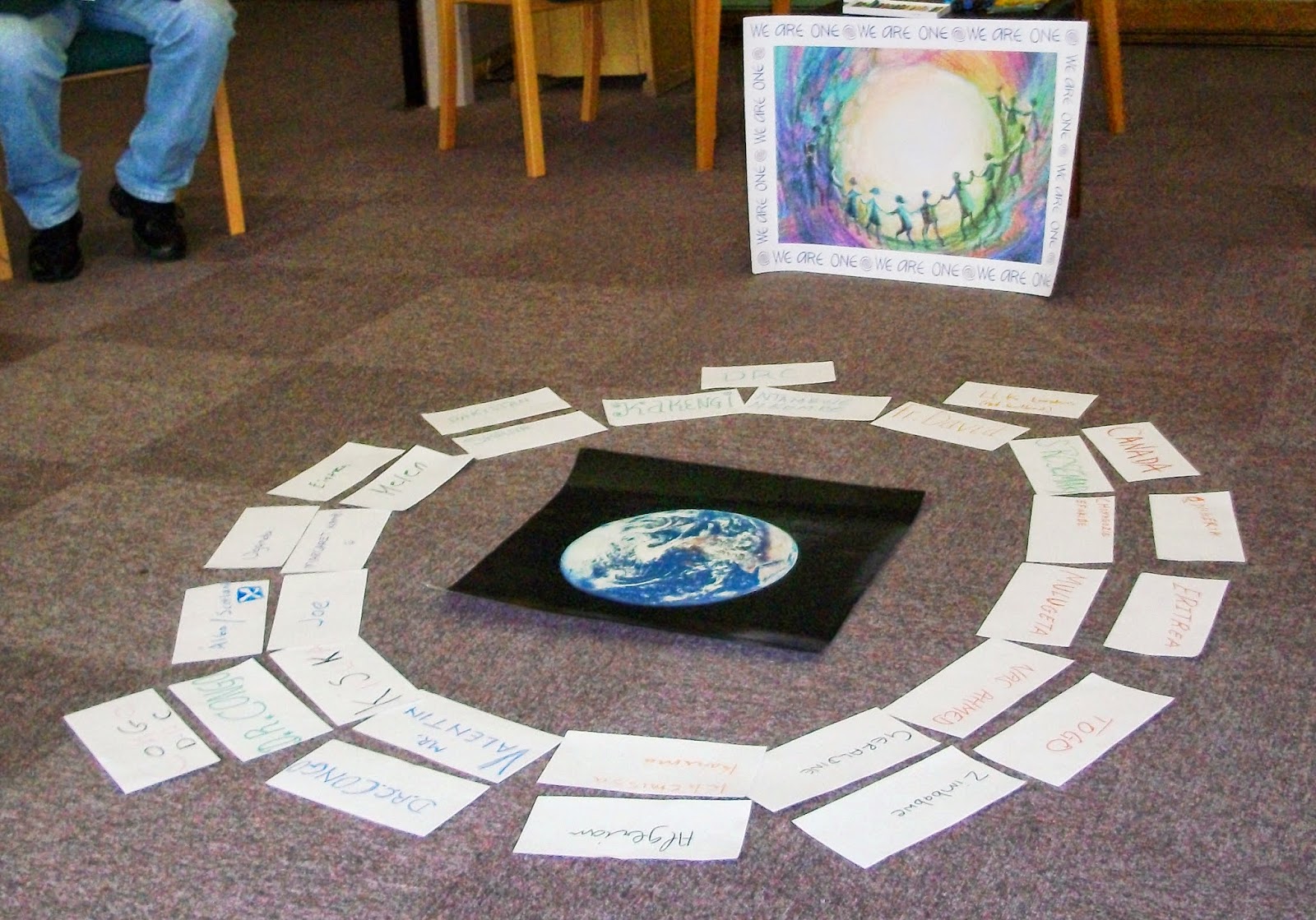
Gonzague is a French Jesuit studying in London. He is currently accompanying a sharing group for men once a month. Here is his reflection on his experience with the people.
Who are we? Once a month we are around 10 that meet from many different places: Nigeria, Eritrea, Ivory Coast, Angola, Algeria, Tunisia, Iran, Pakistan, France, Korea… but also from many different faiths: evangelical Christians, Catholics, Muslims, Atheists. We have only two common points: we are all foreigners and we are all men.
What are we doing? During around one hour we are trying to listen and to speak. First of all we listen to a text, a Biblical text. We read it three times. After the first reading, each one can pronounce one word from the text, which is important for him, after the second reading, one sentence and after the third reading we are invited to share how this text echoes my experience, my life, my beliefs, my struggles. Finally we do not only listen to the text, but also to the others, and from its words and from their words each one can try to express where he is and what he lives.
For what are we doing that? Why are our meetings so joyful? To be honest it is a bit mysterious. While as men we can quite easily discuss about politics, football; but as asylum seekers experiencing destitution and exclusion we are often silent. In this group, we can speak about the experience of detention, of our struggles to continue to live in the dignity, in the good, but also about our hope to have one day a normal life.
Paradoxically being among men helps us to access for one another the deeper good characteristic of our humanity: the Word and our own words. In this group, we can shout to God and to our brothers, “I know that I will live to see the Lord's goodness in this present life. Trust in the Lord. Have faith, do not despair.”
Subscribe to JRS-UK Community Blog by Email
Tag :
accompany,
befriending,
bound together,
community,
crossing bridges,
expression,
friends,
Gospel,
hope,
human beings,
listen,
Crossing Bridges Together
Fr Michael Pastor volunteered with JRS in the UK for six months moving on to undertake his Jesuit tertianship in Chile.

We begin accompanying from the experience of being accompanied. JRS helped me to cross the foreign language obstacle when I came to the UK. Moreover, my crossing this barrier has given me a better understanding of this experience for refugees. I took the place, several times, in the feelings that two young Moroccan guests had to feel in my own Bilbao community back in Spain.
We begin accompanying from the experience of being accompanied. JRS helped me to cross the foreign language obstacle when I came to the UK. Moreover, my crossing this barrier has given me a better understanding of this experience for refugees. I took the place, several times, in the feelings that two young Moroccan guests had to feel in my own Bilbao community back in Spain.
Then, I realised the importance of walking with someone, being present either at lunch or in the day centre, even more when visiting someone. Our presence, before doing anything, says something very important: "Here I am. We appreciate you, you are worth something".
When a refugee feels that he or she is helped and appreciated (accompanied) in our warm, friendly space at the day centre, he or she begins crossing a bridge to go into a new place. This is what JRS UK is doing in either visiting the detention centres or setting up peer support groups such as Women4Women and Men4Men. As well, this is the service they need: to share whatever they are living in their hard situation. All of us need this space to share our lives with someone who listens to us.
But the thing that has taught and touched me more is the hope and strength of human beings when we feel that we ourselves have value. At the third Men4Men meeting, I learnt that life has the strongest power if you are able to listen to and share. And of course, instead of listening to for a while in those meetings, if you offer to a refugee your home, you will feel even more this hope and strength. "At home" we accompany, serve and become advocates of them. It is worth it!!


