Showing posts with label friends. Show all posts
Reflections on my work with Asylum Seekers in London

Subscribe to JRS-UK Community Blog by Email
I have been working with Asylum Seekers for the past almost 16 years, first in Oxford and for the last 6 years in London at the Jesuit Refugee Service UK. The latter is based in Wapping in East London. Most of the people we befriend are based in this poorer area of London.
The Mission of JRS is to: 1) Accompany asylum seekers and forced migrants, our brothers and sisters, 2) Serve them as companions and 3) Advocate their cause in a largely uncaring world. We have a particular concern for those who are detained under the immigration rules and for those who, having had their asylum claim refused – sometimes many times – are left both destitute and homeless in the UK. We try to carry out this work in a spirit of dignity, mutual respect and solidarity and in collaboration with other similar organisations. Our Mission is based on our faith in God, who is present in human history, even in the most tragic circumstances. Our values are: Compasssion, Hope, Dignity, Solidarity, Hospitality, Justice and Participation. We welcome people of every nationality; of all faiths and none. At JRS we do not refer to those who come to us as clients but as friends. To quote one of our friends: “JRS are family for me now. JRS supports me morally and motivates me.”
JRS is open 5 days a week but definitely the highlight of the week is the Thursday Day Centre when we welcome an average of about 100 people. I believe that the most important aspect of what we can offer is that of welcome - a welcome to those who otherwise feel unwelcome in our society. This begins by the welcome given at the door which is so appreciated by those who come. This was brought home to me recently by one young woman who said to me:” I was feeling very nervous when I arrived but I felt so happy when everyone greeted me with a smile and was so kind to me.” Or as another person described it:” We feel welcome as a new person in a new country.” This is so important when they have been anything but welcome in their own country and have met only with hostility on arriving in this land.
As well as the initial interview, the centre gives an opportunity to speak about their situation with volunteers; to receive advice on various matters; to be directed to other organisations e.g. centres for food, clothing, legal aid, health needs, courses for English and other studies; to make friends and sometimes speak their own language over a cup of tea or coffee or just to rest. They can receive a sandwich and fruit lunch and a monthly hygiene pack of toiletries. We also provide travel money for access to critical legal and medical appointments, emergency mini-grants for newly destitute individuals.
I, myself, participate in this work as a volunteer twice a week. My main role currently, together with another Sister of a different Congregation, is to conduct the initial assessment interview of each newcomer to the Centre. We do this in as friendly and informal manner as possible as we know this can be daunting for some of our friends who have had previous traumatic experiences of being questioned. It is gratifying when some, who arrive very nervous and traumatised, leave the room relaxed and smiling. Sometimes the experience for us of listening to what is a harrowing account of what they have undergone, both in their own country and during the asylum process here, can be heartbreaking. I always find the fact that so often, having escaped very difficult and often tragic circumstances from their country of origin, they are received here with both suspicion and hostility. Some of them in the course of the process have been detained in Detention or so-called “Removal Centres” for longer or shorter periods. I myself have visited people in various of these centres and know what a traumatic experience it can be for innocent people to be virtually imprisoned for an indefinite period of time. This is particularly so when children are involved. Another source of trauma is the often long waiting for a decision from their Hearings. Some of the people we interview have been in the UK for 10 years or more without any positive outcome of their claim for asylum. This frequently leads to both mental and physical stress and depression and even suicide attempts. Conversely the UK does currently offer excellent medical care for which they are hugely grateful. There are also some wonderful charitable organisations to which they can have recourse, such as the Medical Foundation for the Prevention of Persecution.
Another traumatic factor for these people to deal with is literally becoming both destitute and homeless when they have exhausted their Appeals. Some are fortunate enough to have good friends who will give them somewhere to sleep but very often they find themselves on the street or sleeping on buses etc. I know of at least one middle-aged Congolese lady who has been in this situation for the last 6 months. We do our best to find places for these people but there are so few available and they are usually full.
We are always so happy when we are able to register those we interview and therefore provide for them the little financial and other help we can on a regular weekly basis. It is truly humbling to witness their gratitude for even so little. This frequently reminds me how grateful I should be for the many blessings I receive on a daily basis.
Another inspiring aspect of my relationship with these people is the weekly Prayer Group for women held every Tuesday. This was requested by the women themselves a few years ago. There is also a similar group for men. A Cenacle Sister and I organise this, taking turns to lead the prayer weekly. At present all the participants are Christian: Catholic and Orthodox but all faiths are welcome. They represent various African countries, including Eritrea and Ethiopia and are English, French, Tigrine and Amharic speaking. I find their deep, simple and devout faith, love of prayer and capacity for silence both moving and inspiring in the face of all they have suffered and are still suffering. Again, I receive far more from them than I can give. This is one of the most rewarding aspects of my work with these beautiful and endearing people. I can truly say;” I feel privileged to meet and learn from each one of my refugee friends. My association with them continues to enrich my life and I give thanks that I have been given the opportunity to participate in this work of God,”
This article first appeared on http://www.assumptionreligious.org/news/151/19/Assumption-focus-on-refugees.html
Tag :
accompany,
asylum seekers,
bound together,
friends,
human beings,
journey,
JRS,
open doors,
reflection,
volunteer,
A Poem
 |
| Photo by Dunbar Gardens, Fotor.com |
One of our refugees, Momodu wrote a poem titled Tuesday. Tuesday is not Sunday, Friday, or Monday. Shall we listen to what he has to say about this day of the week?
Tuesday be lucky
by Momodu
Tuesday be lucky
wake me up stronger
let me catch bus on time
make me not worry
Tuesday be lucky
let me strong
and keep long in the street
bring me knowledge
Tuesday be lucky
day of hardwork
take me safely on my journey
bring not any rain
Tuesday be lucky
let my talent show
bring me peace
Tuesday be lucky
you help me with my day
my day bless
and now I can rest
Subscribe to JRS-UK Community Blog by Email
Tag :
community,
english PEN,
expression,
friends,
JRS,
listen,
pen friend,
poems,
poetry,
reflection,
writing,
All Are Welcome at the Table of God
 |
| A photo by Jürgen Treiber_Fotor.com |
Here is a reflection by Jyoti, who volunteers at the JRS Day Centre since 2
years
The
vision of the JRS Day Centre for me comes from the Bible: the table of God
where all are welcome, regardless of caste or creed. This is the place where all
are given their place, their respect. This is the atmosphere we have here and
this is the welcoming attitude we have for our guests.
I
like of course talking to each person! First of all opening the door… Open the
door, give a smile and a welcoming gesture. It is for me an openness to receive
each one, the receptiveness, and then you see the smile on the other’s side. One
of them who came recently was a new one, it was her first time. The day she
came she was really down, the second time she came here her face was so
peaceful and calm. I asked her and she said it was because I met the cheerful
people, the good people here.
That
is the difference we make. Those who come with their burdens, feelings of what
is happening to them… so even one smile makes a big difference. What I see
differently, what I have learnt myself as a volunteer, well as you can see, a
smile is my main motto here! Sincerely, despite all the difficulties, if they
can smile, what if I can not give a smile. I see that from the other side, so
it brings such a difference.
Then,
I was on the desk for the travel money. Money is a big thing in their life,
they don’t have money, and although we are giving little, it is very supportive
to them as other organisations do not give it, they have no access to money. So
JRS is doing a very purposeful work which can help them to go to the place they
want, the necessary solicitor or reporting at the Home Office. And all the
various activities of course, they are ways of freeing them from the tension. Like
the massage, the touch makes the person feel healed and loved, all the
activities for our guests are very down to earth, and so very helpful for them.
For
me dignity is one JRS value that is important to me. People come to the UK looking for
dignity a good life, but they end up with nobody respecting them. But this is
one of the place that we have that good practice or a very good deep model of
dignity. Overall I feel this is a place of hospitality where one feels at home
and each volunteer and staff member are so open to cater to our guests in a way
they feel welcomed. And of course our compassion to them in their suffering. We
give that to each person, respecting them as they are as a person, regarding
their person as the image of God.
Subscribe to JRS-UK Community Blog by Email
Tag :
accompany,
befriending,
centre,
community,
day centre,
expression,
food,
friends,
human beings,
JRS,
money,
open doors,
peace,
reflection,
refugee,
volunteers,
welcoming,
Advent Together

Kate and Rosemary both took part in Pax Christi’s annual Advent Service at St Aloysius church near Euston in London this week. Kate shares what she enjoyed about the occasion.
Jesuit Refugee Service UK was invited to offer a testimony and focus for prayer for a gathering of people who work for justice all the way through the year. We were together to listen to stories, reflect on scripture and sing. The event was both intercession for people who all year round struggle in impossible circumstances and a festive celebration at the same time.
This service was particularly important to me. It was beautifully designed and presented with a lot of thought and love - whether through the choir, Westminster Deaf Service interpreters or the different creative stations for prayer. It is not often that I feel my worship truly reflects my work and commitment to working for peace. So I am grateful that on occasion we were able to honour refugees, those caught up in the troubles in the Holy Land, women who suffer from violence and those who seek to transform conflict throughout the world.
Each theme had a scripture verse, a personal story, a prayer from Pope Francis or a litany and a song. During the service we were all invited to make a pilgrimage around the church to each area, by way of accompanying people throughout the world who find themselves in situations of flight, discrimination, trafficking or isolation. We sang in English, Arabic and Hebrew and made a commitment to instil in our hearts the courage to take concrete steps to achieve peace. It meant a lot to me to share those words with a mix of people who I know do that in their daily lives.
After the service, we all went downstairs to share a mince pie and glass of wine. JRS had a stall with crafts made by refugees in Kenya (www.jrsea.org/mikono) and sold more than £100 of products. Thank you to everyone who bought something from us.
Read more about Pax Christi’s work: www. paxchristi.org.uk
Read more about JRS’ work in Syria: http://en.jrs.net/campaigns_
The collection was taken for Pax Christi and JRS Syria. You can donate here: https://en.jrs.net/donate
Tag :
accompany,
advocate,
bound together,
Britain,
Christmas,
crafts,
crossing bridges,
friends,
human beings,
london,
peace,
pope francis,
prayer,
reflection,
refugee,
sharing,
visit,
voice,
Poem - In London
 |
| London Eye - by Christopher Chan |
Charles wrote a poem about this city London.
In London
by Charles
In a place where I thought that Big Ben is the best sight to see.
In a place where I thought that Buckingham Palace is the best castle to see.
In a place where I saw green because Wimbledon tournament is on grass and green.
In a place where I thought, women are powerful, because the ruler is a Queen.
In a place where women can choose regardless of their background, as dear Princess Diana did.
But London, with Hooliganism, you gave us the impression that you are not immaculate.
But London, you start your shy revolution with Protestantism.
But London, you gave us the impression that you are the best place to acquire education.
Although you, London are welcoming, life is hard in you.
Although you, London are very tolerant, racism still exists.
Although you, London are equal, competition is tough – London, you may have saved some lives but you did not save our soul.
Subscribe to JRS-UK Community Blog by Email
Tag :
asylum seekers,
bridges,
Britain,
community,
crossing bridges,
friends,
home,
human beings,
listen,
london,
poetry,
reflection,
welcome,
welcoming,
workshops,
writing,
Bon Appetit!

Kate shares her most recent experience of offering hospitality for friends of JRS in the UK
How do you know an evening event has gone well? When you spend all night doing the washing up and everyone brings their plates in saying how delicious the food was! Last week, we were pleased to welcome here a mixture of people to a meal cooked by one of our JRS refugee partners. It was our way of saying thank you to those who help sustain the work of JRS in various ways: as donors, supporters, advisors, volunteers...
Eating together is not unusual at JRS, we do it most lunchtimes: simple bread, cheese, salad, fruit... but this meal was special with tchep rice, spicy harissa chicken, chocolate mousse. All prepared by one of our refugee friends who is completing his training as a chef at a college in London. The occasion gave him a chance to articulate the importance of being accompanied by JRS in his chosen course and for us to appreciate how we all grow together, here in community.
One guest said: "It was a delicious meal and so beautifully presented; it was great to see so many people who love and support our JRS; and it was good to have the chance to have deeper conversations with the people we were sitting near... I know that many people have been enabled to find their dignity and to give them hope through the continuous presence of JRS in their lives."
So here's to many more occasions to celebrate our journeys together, to sit around the table sharing joy in life and to taste delicious food - cheers!
Subscribe to JRS-UK Community Blog by Email
A Pilgrim Journey to Canterbury

“The first day was really an amazing day,” Charles expressed on sharing his experience of the pilgrimage. “We walked through the city of London and we reached Swanly which is 18 miles away from London and there we slept in a church – everybody! - and we had lovely dinner, conversations and so on. The second day we reached a place somewhere in Kent, not far from Ashford. We had a lot of discussion as we walked and the next day we were in Charing. And in Charing we discovered a church that was 700 years old, and the first vicar of the church was patronised by King Henry VIII. And we stayed there, we stayed in a school basically and there was evening entertainment where we organised comic strips, theatres, singers so it was a lot of fun. The fourth day was the last day, so we went to Canterbury. And at Canterbury we had a mass at Canterbury Cathedral.
Unfortunately the archbishop of Canterbury was not there but we did see the Dean of Canterbury and they had a choir. A very lovely choir, very lovely songs and we had a reading from those who are really, the thinkers of helping the community.”
On the second day of the walk, Charles, who has been taking part in a photography workshop at JRS, run by Fotosynthesis, a not-for-profit organisation that uses participatory photography to develop skills, give a voice to people and encourage community cohesion, was inspired by the beauty of the area and the joy he felt to take a photo.
“I just stood and I just opened my hands like this just to say how life is, how nature is beautiful and it just shows that although you are walking and people may feel like it was really painful and hard to walk for four days, after the second day, I was still feeling very happy and enthusiastic because it was for a good cause. It’s for people who need accommodation, who need support in their society, who need food for themselves. So my hands that way, show in life we have to be open to each other, we have to welcome each other, we can help each other, and by such action we can iron out some problem in the society such as homelessness, such as poverty and such as mental health problems.”
Tag :
accompany,
advocate,
beauty,
Britain,
day centre,
expression,
friends,
JRS,
london,
photography,
sharing,
travel,
How many people can you fit around one table?

Greetings in different languages!
Kate, a member of staff, shares one of her favourite things about JRS
How many people can you fit around one table? At JRS today we had 20 people sat around our lunch table. This is one of my favourite things about JRS – we eat together every weekday. Each day, whoever is at the office or community centre sits down together. And then we clear up, wash up and tidy up. It is an important time in our working day and there is usually laughter and news to catch up on.
Mostly we have simple food: bread, cheese, cold meats, houmous, salad and a piece of fruit each. Sometimes if it is someone’s birthday, we share cake. Other times if we have had an event the day before there is leftover pasta or a pudding to eat up. If we are few, we always set an extra place for a late comer or a guest arriving in time for an appointment or meeting. Some days, one of our refugee friends comes to have their only meal for the day. On other days, visitors are caught up in the hubbub of chatting together.
We share stories, we try to learn each others languages and talk very little about work. It is a special time to deepen our relationships, appreciate each others’ culture and feel like a community together. It helps us see people outside of their roles and learn different perspectives in an open and relaxed way. Today we were from 15 countries from across 4 continents: interns, refugee friends, Jesuits, volunteers, members of staff… each one welcome in their own right and appreciated for who they are.
Subscribe to JRS-UK Community Blog by Email
Tag :
befriending,
bound together,
bridges,
community,
food,
friends,
open doors,
wapping,
welcome,
welcoming,
Men for Men: Listen the Word to Pronounce Our Own Words
Gonzague is a French Jesuit studying in London. He is currently accompanying a sharing group for men once a month. Here is his reflection on his experience with the people.
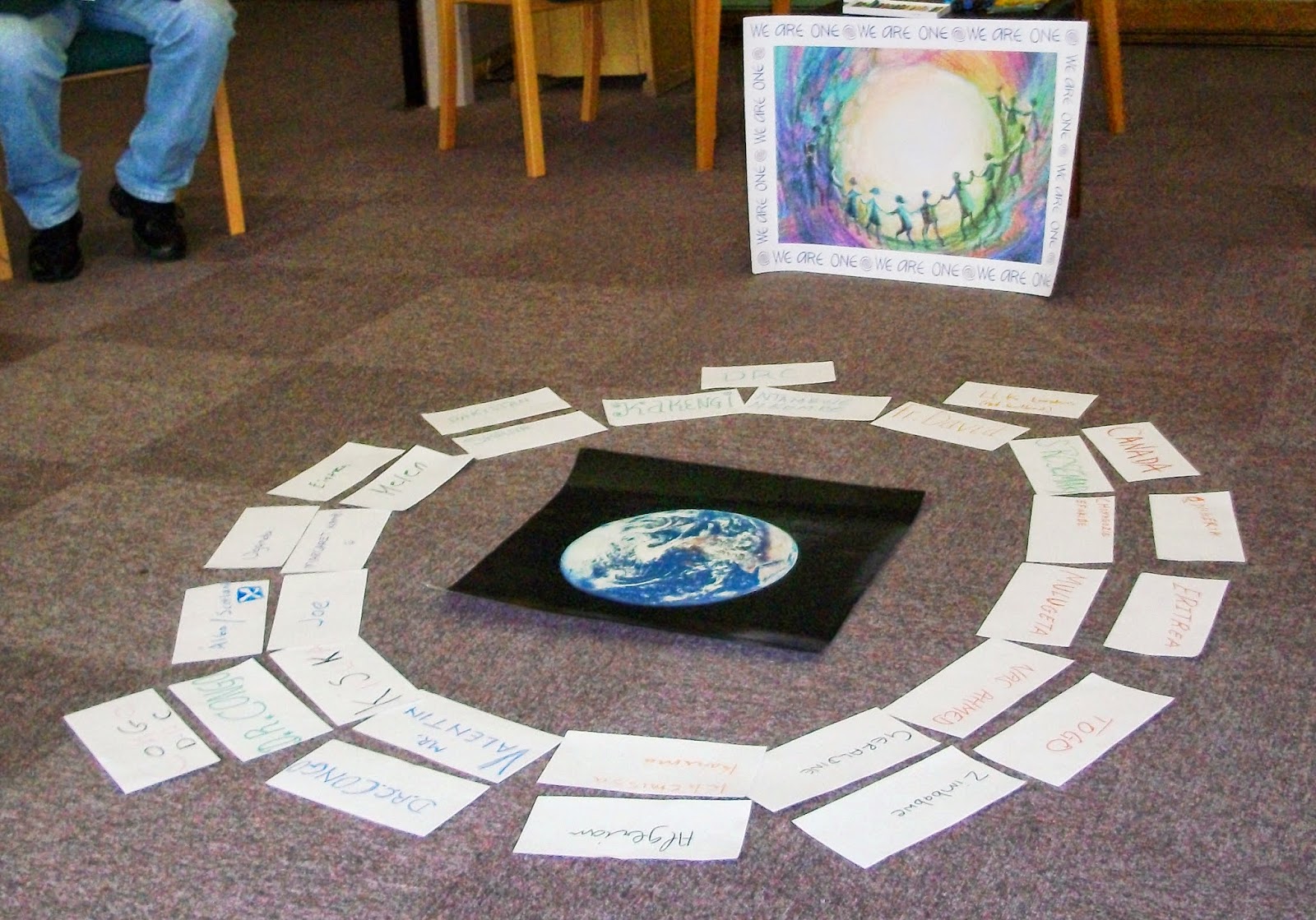
Who are we? Once a month we are around 10 that meet from many different places: Nigeria, Eritrea, Ivory Coast, Angola, Algeria, Tunisia, Iran, Pakistan, France, Korea… but also from many different faiths: evangelical Christians, Catholics, Muslims, Atheists. We have only two common points: we are all foreigners and we are all men.
What are we doing? During around one hour we are trying to listen and to speak. First of all we listen to a text, a Biblical text. We read it three times. After the first reading, each one can pronounce one word from the text, which is important for him, after the second reading, one sentence and after the third reading we are invited to share how this text echoes my experience, my life, my beliefs, my struggles. Finally we do not only listen to the text, but also to the others, and from its words and from their words each one can try to express where he is and what he lives.
For what are we doing that? Why are our meetings so joyful? To be honest it is a bit mysterious. While as men we can quite easily discuss about politics, football; but as asylum seekers experiencing destitution and exclusion we are often silent. In this group, we can speak about the experience of detention, of our struggles to continue to live in the dignity, in the good, but also about our hope to have one day a normal life.
Paradoxically being among men helps us to access for one another the deeper good characteristic of our humanity: the Word and our own words. In this group, we can shout to God and to our brothers, “I know that I will live to see the Lord's goodness in this present life. Trust in the Lord. Have faith, do not despair.”
Subscribe to JRS-UK Community Blog by Email
Tag :
accompany,
befriending,
bound together,
community,
crossing bridges,
expression,
friends,
Gospel,
hope,
human beings,
listen,
A place just "to be"...

A personal reflection from a JRS volunteer, Sr Juliana, who offers her thoughts after being with JRS for a couple of months...
My journey at Jesuit Refugee Service, it all started during our CSJP's Congregation (Congregation of Sisters of St. Joseph of Peace) experience here in London, as we explore where God is calling and leading us for future ministries in accordance with the signs of times and the needs of the world today. Right form that day something really touched and stayed with me, I felt something within, is had to name and to express what it is.
JRS as an international catholic non-governmental organization with a mission to accompany, serve and defend the rights of refugees and forcibly displaced people; is very much in line with our Charism of Peace through Justice. The question is often asked, why on earth should one had anything to do with ex-offenders, law breakers. Others feel that these people should get what they deserve and go where they belong. This attitude deeply touched and challenged me when I hear these words towards refugees and asylum seekers. At the same time what a remarkable witness of people who are willing to risk their lives by trying to live against this way of thinking, the logic and standards of the world; by working with people on the margins, helping those that nobody wants to help in terms of political, socio-economic and national policies and structures. With individuals not given a fair and good hearing and unfairly treated.
As a CSJP invited to follow in the footsteps of Jesus, I questioned myself how do I live and apply the Charism of Peace through Justice where people are not respected, believed in or listened to and considered as individuals and persons? Why do I choose to go to JRS? It was because as CSJP I am called to live and think differently from the logic and standards of the world, to live in a new way the concept of basic human rights – our common humanity that fosters mutuality equality. I was welcomed within the team at JRS, making it possible for me to fit in very well, and we really worked very well together.
The situations of all those that visit the centre are very complex, difficult and sad, but the team acting as a community where everyone is family really makes a huge difference for the friends receiving service. As Henri Nouwen said: "Hospitality is primarily the creation of free space where the stranger can enter and become a friend instead of an enemy". I was involved in the administration (updating files, reception and welcoming); Day Centre (variety) and the women's group. The main purpose of the work with the women is to see to their personal well-being - physical, emotional, moral and spiritual (activities like relaxation exercises, reflexology and contemplative prayer circle are offered to help them) All of this aims to create a place for them just "TO BE", a time of relaxation and companionship. For me, the group itself was a witness: there are no barriers, no best way, no better language, and no better expression! We relate to God as we are and in the same way we relate to one anther. There were times when I was challenged and really experienced my own poverty, because many times I didn't feel I was actually doing anything, I had just to sit with the participants, even if communication was difficult. The communication of acceptance, equality and that atmosphere of shared common humanity spoke more than anything indeed. I became aware that sometimes even without words my attitudes can be discriminating and marginalizing of others. My experience at JRS, what really stayed with me is that "If I can't change people's situation, but I will try to love them".
Subscribe to JRS-UK Community Blog by Email
Volunteering at JRS, the Day-Centre

Mike Guilfoyle, talks about his experience as a JRS volunteer.
Following my departure from having completed a twenty year ' stretch ' working as a front -line Probation Officer in London in 2010. I started to look around for new and energising pathways into working outside the statutory sector and in particular fulfilling a long standing interest in working as a Volunteer. After experiencing some unexpected setbacks, I was informed by one well known charity having made what I took to be a convincing presentation, that I was unsuitable as I appeared to have not quite stepped outside the probation officer persona! Undeterred, I directed my attentions to an altogether different area of volunteering, that I had peripherally engaged with albeit in the context of casework supervision with ' foreign national' prisoners when working as a probation officer.
Having already written articles for the Catholic Social Justice Quarterly, Justice Magazine, on how my catholic faith had informed my approach to working with those who came into contact with the criminal justice system, it seemed fitting that having contacted the Mount Street Jesuit Centre and had the estimable pleasure of an informal interview with Andrea Kelly that I was directed (I have now nearly completed my novitiate!) towards the Jesuit Refugee Service. At the time, JRS was relocating from its former base in North London to Wapping and as such I awaited with keen anticipation the much delayed meeting (due to the aforementioned migration across London) with JRS Assistant Director Jonathan Parr. The convivial and engaging process of volunteer recruitment was then wonderfully complemented by the presence of a warm, welcoming and eclectic staff group.
Although I had expressed a preference for working as a volunteer visiting those caught up in the Orwellian world of detention centres, childcare considerations meant that this option has remained , at least for the present, impracticable. Since then I have willingly given up a chunk of my Thursdays to work in the vibrant and challenging weekly Day-Centre that is at the heart of the Hurtado Centre and this has offered a richly uplifting experience which has meant so much to me, anchored as it is in the foundational principles of catholic social thought, respecting the dignity of the human person, who is possessed of a god -given worth captured so well in Matthew 25: ' If you welcome the stranger, you welcome me'
I was mildly amused to note that the Jesuits also have what they define as House Probation , that is novices perform most of their basic but essential tasks , alongside their heroically lengthy but to the secular outsider, formidable period of formation. I can honestly state that the time I have so far spent at JRS has been unremittingly rewarding and has offered me a privileged opportunity to meet with, work alongside and support the refugees, many of whom offer their greetings and friendship, when they arrive at the Day-Centre and prior to leaving. I now feel a warm attachment and measured respect for those friends whose stories of displacement and rejection, have resulted in unmerited penury reliant on the charitable support of JRS and other voluntary bodies. In making oneself available often at times of great individual distress, by opening up an emotional space and presence and active compassionate listening. I have always tried at moments when my patience or attention is lacking, to recall the enduring words of Holocaust survivor Elie Wiesel, ' If I see a person or persons suffer and the distance between us does not shrink, then my place, is not good, not enviable'.
I was mildly amused to note that the Jesuits also have what they define as House Probation , that is novices perform most of their basic but essential tasks , alongside their heroically lengthy but to the secular outsider, formidable period of formation. I can honestly state that the time I have so far spent at JRS has been unremittingly rewarding and has offered me a privileged opportunity to meet with, work alongside and support the refugees, many of whom offer their greetings and friendship, when they arrive at the Day-Centre and prior to leaving. I now feel a warm attachment and measured respect for those friends whose stories of displacement and rejection, have resulted in unmerited penury reliant on the charitable support of JRS and other voluntary bodies. In making oneself available often at times of great individual distress, by opening up an emotional space and presence and active compassionate listening. I have always tried at moments when my patience or attention is lacking, to recall the enduring words of Holocaust survivor Elie Wiesel, ' If I see a person or persons suffer and the distance between us does not shrink, then my place, is not good, not enviable'.
Working at the JRS has helped me to see in the vulnerable stranger a mirror of myself, and a reflection of Christ that points towards an invitation to human solidarity. I have met some truly wonderful colleagues, some of whom have since moved onto other challenges and career openings. The ready wit, cheerful banter and ' salty' humour in evidence when volunteers come together has been a source of joy and delight to me, the ' passagiato' practised with consummate ease by one of the volunteers now studying for a higher degree! will no doubt be recognised by 'front of house' volunteers! An invitation to accord greater attention and support to those marginalised by political strife and persecution and broken by personal tragedy was recently reiterated in the Apostolic letter in anticipation of the World Day of Migrants and Refugees from Pope Francis which concludes with these resonant words: 'Dear migrants and refugees! Never lose the hope that you too are facing a more secure future, that on your journey you will encounter an outstretched hand, and that you can experience fraternal solidarity and the warmth of friendship! To all of you, and to those who have devoted their lives and their efforts to helping you, I give the assurance of my prayers and I cordially impart my Apostolic Blessing.'
Swordfish with Vegetables Congo style!

A delicious recipe by one of our friends from DRC
Ingredients for 4 servings
1 kg of salt swordfish
2 aubergines peeled and roughly chopped
2 peppers (red and yellow) roughly chopped
2 spring onions trimmed and roughly chopped
2 cloves of garlic
2 fish stock cubes
Half a glass of water
Olive oil
Directions
- 48 h before put the swordfish in water to remove the salt.
- Put olive oil into a pan and fry the fish. Once fried, reserve the fish for later.
- In the same oil that you have fried the fish fry now the peppers. Add the aubergines and the garlic and mix everything together. Now add the fish stock cubes and the water. Cook it in low fire and finally add the onions.
- Once the vegetables are ready serve them on top of the fish. This dish goes very well with steamed rice on the side!
Subscribe to JRS-UK Community Blog by Email
A very special courgette

Today at JRS, I spent a long time chatting with one of our long-time friends who comes to see us each week.
We both share French as our second language which comes in very handy for helping to translate complicated letters from the hospital or other official correspondence from English into the essential information she needs. It also means that we can talk together about family problems and exchange perspectives on how we deal with issues in our respective cultures.
Sometimes, it can feel like my patience is running out as I struggle with vocabulary or look at a letter for the fifth time as she takes it out from her filing system of envelopes and plastic bags. I am mindful that I am not attentive enough or that my mind strays back to the paperwork that feels more urgent. And yet, I love chatting with this lady.
She feels to me like a grandma that I miss, an auntie or wiser woman whose wisdom I only have a taste for. She has lived more challenges than I know and counts friends here in the UK a small compensation for her family who is spread out in different places, all far from her country. She has a great faith and loves to sing and the best smile with a twinkle in her eye that you can catch on a day when the sorrows of life here as an asylum seeker don’t overwhelm her.
It turns out that in the midst of her travails, she loves planting vegetables and before we ended our conversation for the day, she gave me carrots and courgettes to take home for my tea. I shared them with another refugee colleague and took one home to cook with friends this evening.
I felt very proud to tell my friends that this courgette I had brought to our pot-luck supper was grown by my refugee friend. A very special courgette indeed.
By KM
Subscribe to JRS-UK Community Blog by Email
Hospitality

The main subject of discussion during the annual JRS meeting in Portugal was hospitality. Hospitality is the welcome, one of the most important things that we do in JRS.
JRS is going to run a hospitality campaign around hospitality, community and destitution. The word community came up for me. I think it is important being able to form a community for the refugees. For example, through church or through activities like sports. In the UK, we do that with all the activities and workshops we offer such as the creative writing sessions. Through those activities, refugees can become a part of something and belong to a community, in contrast with the isolation they live in when they first come. They feel that they are not out on a limb and more a part of us, as we are part of them, feeling all part of the same community.
I believe we are doing the best that we can in the UK, although we are sometimes limited as an organisation because of the way things are politically here. Hospitality first and foremost is about being a welcoming presence, being a place of safety for people to come to where they feel accepted and safe. It would be wonderful if we had the means, if we could for example provide accommodation for the homeless people who come here. I would love to be able to do that!
The trust that asylum seekers have in us comes quickly, and you can see a change in people thanks to the hospitality we offer. At first, they are apprehensive but later, they see that we are just here to help them and the next time they come they are all smiles.
The Portuguese team put hospitality into practice with us, the participants. They went out of their way to make the everyday really interesting and enjoyable. I felt how I want our refugees to feel when they come to us. It has made me realise even more how it feels for those we see.
From Sister Bernadette
Subscribe to JRS-UK Community Blog by Email
Tag :
accompany,
asylum seekers,
bound together,
community,
Europe,
friends,
home,
Jesuits and Friends,
welcome,
The needs of urban refugees

Sister Bernadette has been working 4 years with JRS. Before that, she spent 10 years with Asylum Welcome in Oxford, co-ordinating English classes and the advice team. She shares her reflections on the different contexts for urban refugees here in the UK and in Portugal.
The purpose of the meeting this year’s JRS Europe meeting was the theme “The Refugee in the Urban Context”. We looked at how JRS can respond to the needs of urban refugees. The meeting offered a comparative approach on how different countries deal with the same issues, all with the ultimate same aim.
In contrast with JRS UK, JRS Portugal works mainly with migrants and just 5% of refugees, plus they run a night shelter for 17 people. Also, in Portugal, migrants are supported by governance subsidies and they are allowed to work. Migrants there normally do an apprenticeship during which they are not paid, but if they do well they can get a paid job in future. For example, we had the chance to meet a young man, who in his own country had been a professional footballer and now taught skills to children. We also went to visit an elderly people’s centre where some migrants were working as well. These examples show that the context in Portugal is different to here in the UK.
Generally speaking, it was very interesting meeting people from different European countries like Albania, Romania, Macedonia or Ukraine. I found the wide representation of JRS across Europe very helpful. Some of the participants were from the main office; some were volunteers and some members of staff. There were a lot of young people, especially volunteers. I found it surprising to be invited as a volunteer as I thought the meeting would be just for staff! This meeting gave me a wider view of what JRS is and how it works in Europe. To me it was like looking at the wider church family which I found it quite inspiring.
Subscribe to JRS-UK Community Blog by Email
Reflection: volunteering with JRS
 |
| "…the beggar stretches out his hand not to ask but to give you the Kingdom of heaven and yet you do not see..." Elder Arsenie (photo: JRS malta) |
In certain respects the Spiritual Wisdom of a Romanian Monk who lived through some of the most turbulent and unhappy periods of world history in the 20th Century might well seem to be far away from 21st Century Wapping. However, the teaching which Elder Arsenie gives was proven to be correct – in my own experience – over the past year when I worked as a volunteer with the Jesuit Refugee Service (JRS).
I was not, on one level, working with beggars but I was working with destitute Asylum Seekers – among the poorest and most misunderstood members of British Society. In the current debate on Asylum and Immigration – fuelled by the wish of all political parties to appear ‘tough’ – it is fashionable only to talk about how much Sanctuary Seekers cost: how much money might be ‘lost’ from the NHS or the DSS (despite many Sanctuary Seekers being denied any basic support at all); how much pressure is being placed on the education system; the transport infrastructure; the housing stock etc etc What is not talked about – and what needs to be talked about – is how much is contributed by those who come – through no fault of their own – to claim Sanctuary in the UK.
The Government forbids our refugee friends to work and from that point of view their financial contribution is minimal. Spiritually, however, their contribution is immense. During my time in Wapping I have met some of the most remarkable, kind and loving human beings I have ever encountered and it has been my privilege and joy to serve them and to accept their immense giftedness. That this has become clear to me is largely due to the Ignatian ethos of the JRS which encourages the volunteers to simply ‘be’ with the person in front of them, seeing them as neither a problem nor a cause but a Brother and Sister in Christ; a human being who, like all humanity, reflects something of the wonder of God. I have now left London and am living in a very different setting in Northumbria but I can safely say that I will take from my experience in JRS some truly wonderful lessons. I will take all that our friends have given me and I will also carry with me the example set by those who work ‘full time’ with JRS – both volunteers and staff.
I looked at the person opposite me; the person who had been tortured; deprived of their basic human dignity not only by the regime they were fleeing but our own Government and I saw Christ in them and in seeing him I saw the Kingdom of Heaven.
Subscribe to JRS-UK Community Blog by Email
Not Just Another Statistic

Thirty seven years, or so we are told, is the time it will take to clear the backlog of immigration cases. Thirty seven years if we continue work at the current rate and if no new cases are filed.
This is just the sort of statistic that both shocks me as a reader and numbs me. How can I take on this statistic when so many others about other dreadful issues follow in its wake? What can I possibly do about a 37 year waiting list?
Writing a letter each week to a man I know nothing about, in a detention centre I can hardly imagine, is a seemingly negligible response, and yet through the pen-friend service that JRS operates, I am able to reach out, to touch and be touched in a way that makes a statistic come alive.
No discussion of politics, religion or individual cases is permitted and every letter is scrutinised by staff at the centre so each week I write about life in rural England, MOR TV, festivals and celebrations. I write in faith that my commentary will be accepted by a stranger. Every month or so I am humbled to know, through the medium of an exuberant, greetings card made in the art class at the detention centre, that my gesture has been graciously received.
Because of this one to one contact, I've found myself reading, thinking and praying about refugees, those who serve them in the host country, those they leave behind in their home countries. I've found myself getting a sense of the scale of the problem, but rather than being overwhelmed as by dry statistics, I discover greater depths of compassion and am moved to immerse myself more fully. Let us hope that by the Grace of God another thirty seven years of letter writing for this particular cause will not be needed.


