Showing posts with label listen. Show all posts
It is wonderful to speak out

Subscribe to JRS-UK Community Blog by Email
What can we do together to improve the lives of asylum seekers here in the UK? JRS UK staff and advocacy volunteers share what advocacy means to them.
Sr Margaret Baxter SSMN, Detention Outreach Co-ordinator, helped two detainees give evidence to the UK parliamentary inquiry on detention via a video link, co-wrote JRS UK’s submission to the inquiry and herself also spoke at the launch of the report.
"For me, being involved with advocacy means to create an opportunity for the detainees I work with to self-advocate, then to help them prepare. For example, for the detention inquiry, we all wanted to be clear on what we wanted to say, so that it was a balance of their experience. On the moment of the hearing, I sat with them and then took each one into the room and then left, to allow them to speak for themselves. When they came out of the interview, I saw a liberated delight in these young men who had been empowered and now able to speak for themselves. That their stories were taken with credibility was in contrast to their experience of coming into country and making their asylum application against disbelief. There is nothing like the sincerity of the person themselves advocating on their own behalf. And with the detainees, there is a sense of solidarity with one another, even in the midst of their vulnerability."
Souleyman Sow, refugee poet and anti-detention campaigner, used to attend JRS UK’s Day Centre and now often speaks at events to explain the negative impacts of detention on the lives of vulnerable detainees, most recently at a school sixth-form education day.
"To be honest, before getting involved in campaigning, I did not know where I was, I had nowhere to start. It lifts me up and puts me on my feet and without it I would be somebody else. My main message is detention. It has an impact, it keep people in limbo. So to decision makers, I say that we have to put detention on trail, it is a waste of tax payers’ money. And let’s have a time limit on detention and we will see some of the problems for detainees ended. It is wonderful to speak out, I have been a tour guide, I have spoken at the parliamentary inquiry. Advocacy is not about money, it is not about food - you have to get involved in the community, after your release what have you contributed to the community? When I see my colleagues, I tell them come and get involved. So just involve yourself!"
A simple mind and heart to reciprocate

Subscribe to JRS-UK Community Blog by Email
Paul Anthony, a Jesuit scholastic and member of the Hurtado Jesuit Community that lives with JRS UK, reflects on a recent conversation about migration.
I was fortunate to attend the session on ‘Migration Conversation’ by Br Stephen Power SJ at the Hurtado Jesuit Centre. It was very informative and the statistics presented were an eye opener. Later, we had a discussion in different groups and I was very much drawn to their sharings. Some of the participants were migrants themselves. Many shared their feelings of sentiments, and what they did with migrants and refugees. What they said was inspiring and heart touching and came from deep down themselves.
When I was in Andhra Province (one of the South Asian Provinces of Society of Jesus), I used to share more often about JRS and its mission to the novice candidates, and in my Vocation Promotion talks to them. The little knowledge I was gleamed from books and newsletters of our congregation I never had met any refugee or volunteer working in JRS. Now I am fortunate enough to be placed in the Hurtado Jesuit Community, in London, as a part of my theology studies. JRS is part of Hurtado Jesuit community’s mission, now I can meet people involved in refugee works as well as asylum seekers and refugees as well. My interaction with refugees is short but it has created a huge impact on me. Simple ‘smiles’, ‘hellos’ and ‘goodbyes’ produce ripples of happiness and joy in their faces. I am not able to advise them on legal matters but simply present myself and share the rapport of a mutual smile. My experience has been similar to that of all those who shared during the discussions, though their sharing has enriched my understanding and feelings towards refugees and migrants.
It is not qualification and experience which matter to have but a simple mind and heart to reciprocate ‘Hi’, ‘Hello’ to those who are in need. ‘When I was hungry, you gave me to eat and when I was thirsty, you gave me to drink’. People not merely long for the satisfaction of physical needs but also for emotional and relational needs. They are hungry for the food of communication and communion and thirsty to receive the water of compassion and acceptance. They desire a space to share their feelings.
The sharing was a great breakthrough and showed me how I need to respond and grow spiritually. It made me realise that the best present I could give to the refugees is my pleasure at our presence together. I have discovered ways to make others happy and to be happy myself.
A Poem
 |
| Photo by Dunbar Gardens, Fotor.com |
One of our refugees, Momodu wrote a poem titled Tuesday. Tuesday is not Sunday, Friday, or Monday. Shall we listen to what he has to say about this day of the week?
Tuesday be lucky
by Momodu
Tuesday be lucky
wake me up stronger
let me catch bus on time
make me not worry
Tuesday be lucky
let me strong
and keep long in the street
bring me knowledge
Tuesday be lucky
day of hardwork
take me safely on my journey
bring not any rain
Tuesday be lucky
let my talent show
bring me peace
Tuesday be lucky
you help me with my day
my day bless
and now I can rest
Subscribe to JRS-UK Community Blog by Email
Tag :
community,
english PEN,
expression,
friends,
JRS,
listen,
pen friend,
poems,
poetry,
reflection,
writing,
Here and Now - a wisdom from the East

Photo by Mike Pedroncelli at Foter.com
We are going through the Lenten season. At the same time, the spring is coming, too! What would be true penance and true appreciation of life? This week, we listen to a wisdom from Buddhist tradition, which Sr Marguerite shared with us.
We are not capable of being alive in the present moment. We tend to postpone being alive to the future... now is no the moment to be alive. We may never be alive at all in our entire life.
Therefore, the technique, if we have to speak of a technique, is to be in the present moment, to be aware that we are here and now; and the only moment to be alive is the present moment.
THIS is the moment that is real.
To be here and now, and enjoy the present moment, is our most important task.
- Thich Nhat Hanh
Subscribe to JRS-UK Community Blog by Email
Let Us Listen to Your Voices: Keep Calm and Send the Feedback In!

Dear Readers,
This week, JRS-UK community blog wants to ask you about how you think of our blog. Since 2013, we have been posting different stories from our JRS-UK community members: refugees, volunteers, and staff. We try to include various voices that constitute our JRS UK community.
Among different stories in our blog, what post do you like most and why? What kind of stories would you like to hear? We would like to listen to your opinions. Please feel free to send in your feedback by emailing us at uk@jrs.net.
Thank you very much!
Subscribe to JRS-UK Community Blog by Email
From Persecution to Punishment: A Second Exile

Together with Sr Margaret from JRS, Souleyman gave a workshop to Fifth Former’s of Stonyhurst College. We asked him his impressions and reflections after the workshop.
He was grateful that the hall welcomed them warmly. For him, the students showed ‘a scholarly purposefulness and positive approach’. He was also happy to see the pupils listen very intently and show ‘honest desire’ to know about the detention situation for asylum seekers in this country.
In the workshop, he posed the question “what part of our mission statement do you believe to be primary and vital?’ After a careful thinking, a young man suggested that it was ‘accompaniment, as a platform to explore’ and ‘the impact of being a healing presence in a very negative environment’. It was a person-centred approach to the issue of detention.
Souleyman saw that the students were particularly interested in personal stories. They were thirsty to understand questions and realised prayer always supports detainees. They also understood how important it is to write to their MPs. Responding to their desires to surf and broaden their knowledge about the issue, he gave the students the addresses of some of the useful Internet websites.
At the end of the workshop, Souleyman prayed together with over three hundred students in Stonyhurst College. Here is their prayer, or rather, a prayerful poem.
God’s plan is always the best.
Sometimes the process is painful and hard.
But don’t forget that when God is silent,
he’s doing something for you.
Subscribe to JRS-UK Community Blog by Email
Tag :
accompany,
advocate,
asylum seekers,
college,
crossing bridges,
JRS,
listen,
reflection,
young people,
Three Types of Listening
 |
|
Photo by Steven Shorrock, from Flickr.com
|
Jesuit Refugee
Service UK is based at the Hurtado Jesuit Centre in East London. The Centre has
just completed a “listening exercise” in
the local neighbourhood. Kate, who works with JRS and at the Centre reflects on
the importance of listening when we are building relationships with other
members of our community.
What does listening
mean to you? What does the dictionary tell us it might mean? Here are three
meanings I found: “to give one’s attention to a sound” i.e. to be attentive, to
give ear to, to concentrate. Another
meaning: “to take notice and act on what someone says” i.e. follow what they
say, bear it in mind, take it into consideration, an active response to a request or some advice shared. And finally:
“make an effort to hear something, be alert and ready to hear” i.e. a sense of
listening out for something that might be missed, trying to catch something at
a deeper level or from a place
beyond where we already are.
Over the last six
months, at the Hurtado Jesuit Centre, we have set time aside to build
relationships with our neighbours and community partners in Wapping and across Tower
Hamlets. This meant us concentrating our attention on those around us, being
curious about their work, caring enough to find out what their needs are and
enjoy getting to know them. Sometimes it meant easy connections, otherwise it
was about popping by, building trust and creating space to listen.
Now we are at the
stage of reflecting on what we have heard: it is about taking notice of what
people were generous enough to share with us. Now we have gained the privilege
of being welcomed into other people’s projects and priorities, we need to
follow up on what they have said, to consider it carefully and explore with them
how we can act on what they have said matters to them. This is less about us
reaching out to offer something to others, but a process of getting to know
another and developing something jointly.
And as we search for
a sense of what is beyond where we are now, in terms of our programme, we hope
that we will be alert to the unexpected, open to fresh wisdom and willing to
respond to surprises. Community engagement is never boring, but hopefully we might
avoid being so busy that our imaginations get tired or that we get pressured
into taking the easy option. So we trust that as our Centre grows in maturity,
we continue to have time to welcome people each week, be responsive to real problems
and get involved in creative, challenging activities.
I wonder if these three types of
listening are ones that we can all bear in mind as we go about our busy
community work in our neighbourhood and local borough? To listen to one another
with respect as we share different perspectives and learn something new. To
listen with a view to putting what we have learnt into action, to really make a
difference in practical ways. And to listen out for that deeper wisdom or clues
for future community needs, changing trends and creative opportunities to work
together over the months ahead.
Read the
report of our findings “Welcome to Wapping: The Value of Community in a Tower
Hamlets Village” . One of the themes emerging from the report is Migration and
Immigration which will be developed with JRS-UK.
Subscribe to JRS-UK Community Blog by Email
Tag :
accompany,
bound together,
Britain,
centre,
community,
human beings,
Jesuits and Friends,
JRS,
listen,
london,
open doors,
reflection,
voice,
wapping,
Poem - In London
 |
| London Eye - by Christopher Chan |
Charles wrote a poem about this city London.
In London
by Charles
In a place where I thought that Big Ben is the best sight to see.
In a place where I thought that Buckingham Palace is the best castle to see.
In a place where I saw green because Wimbledon tournament is on grass and green.
In a place where I thought, women are powerful, because the ruler is a Queen.
In a place where women can choose regardless of their background, as dear Princess Diana did.
But London, with Hooliganism, you gave us the impression that you are not immaculate.
But London, you start your shy revolution with Protestantism.
But London, you gave us the impression that you are the best place to acquire education.
Although you, London are welcoming, life is hard in you.
Although you, London are very tolerant, racism still exists.
Although you, London are equal, competition is tough – London, you may have saved some lives but you did not save our soul.
Subscribe to JRS-UK Community Blog by Email
Tag :
asylum seekers,
bridges,
Britain,
community,
crossing bridges,
friends,
home,
human beings,
listen,
london,
poetry,
reflection,
welcome,
welcoming,
workshops,
writing,
Men for Men: Listen the Word to Pronounce Our Own Words
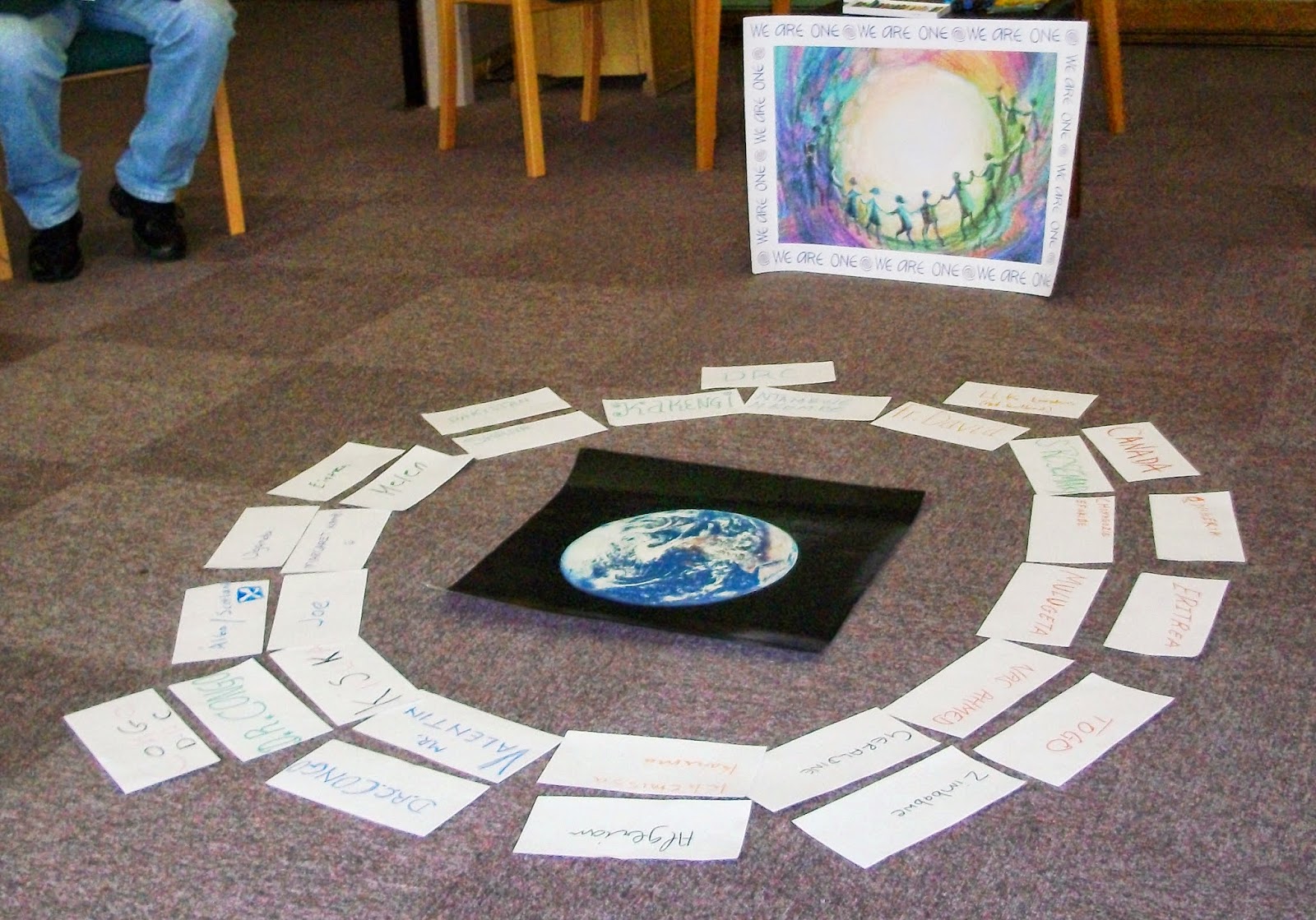
Gonzague is a French Jesuit studying in London. He is currently accompanying a sharing group for men once a month. Here is his reflection on his experience with the people.
Who are we? Once a month we are around 10 that meet from many different places: Nigeria, Eritrea, Ivory Coast, Angola, Algeria, Tunisia, Iran, Pakistan, France, Korea… but also from many different faiths: evangelical Christians, Catholics, Muslims, Atheists. We have only two common points: we are all foreigners and we are all men.
What are we doing? During around one hour we are trying to listen and to speak. First of all we listen to a text, a Biblical text. We read it three times. After the first reading, each one can pronounce one word from the text, which is important for him, after the second reading, one sentence and after the third reading we are invited to share how this text echoes my experience, my life, my beliefs, my struggles. Finally we do not only listen to the text, but also to the others, and from its words and from their words each one can try to express where he is and what he lives.
For what are we doing that? Why are our meetings so joyful? To be honest it is a bit mysterious. While as men we can quite easily discuss about politics, football; but as asylum seekers experiencing destitution and exclusion we are often silent. In this group, we can speak about the experience of detention, of our struggles to continue to live in the dignity, in the good, but also about our hope to have one day a normal life.
Paradoxically being among men helps us to access for one another the deeper good characteristic of our humanity: the Word and our own words. In this group, we can shout to God and to our brothers, “I know that I will live to see the Lord's goodness in this present life. Trust in the Lord. Have faith, do not despair.”
Subscribe to JRS-UK Community Blog by Email
Tag :
accompany,
befriending,
bound together,
community,
crossing bridges,
expression,
friends,
Gospel,
hope,
human beings,
listen,


